
What is Presbyond LBV and Who is it for?
Presbyond LBV is a type of laser surgery for people over 40 who struggle with near vision (presbyopia). It creates a “blended vision” profile that lets you read, drive, and use digital devices without glasses. Presbyond LBV is a blended vision laser procedure during which the surgeon individually corrects distance vision in one eye and near vision in the other, creating an optimized 「Blend Zone」—the intermediate range of vision—to enhance depth of focus. Through detailed preoperative measurements and calculations, we determine the scope of your personalized 「Blend Zone」 and perform targeted corneal reshaping with a laser.
After the procedure, each eye can independently adjust its depth of field, while the 「Blend Zone」enables the brain to merge overlapping images from both eyes, forming a three-dimensional visual perception and achieving true binocular vision. This allows for clear sight at far, intermediate, and near distances without reliance on glasses. Most patients experience immediate improvement in their vision after the surgery.
Professor Dan Reinstein, Medical Director of the EuroEyes Group International Medical Advisory Board, has developed “Presbyond Laser Blended Vision (Presbyond LBV)”, a eye laser treatment for patients over 40, which avoids the need to replace the natural lens with an artificial lens.
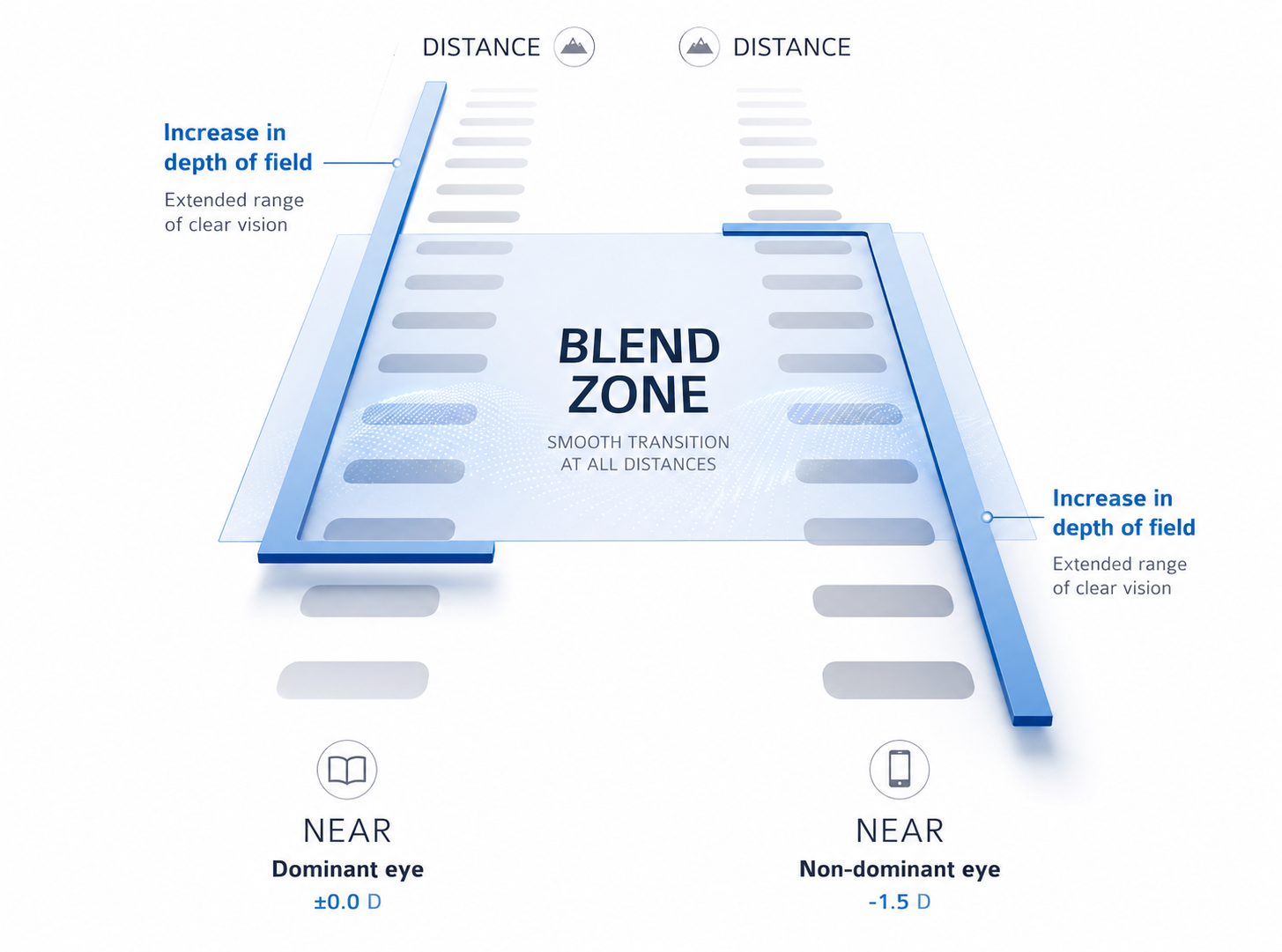
The "Blend Zone", which is individually calculated for you, ensures that you can see sharply in all areas.
The 「Blend Zone」of Presbyond LBV is meticulously calculated through personalized algorithms, resulting in up to 97% of patients achieving ideal vision after the procedure (in contrast, the tolerance rate of monovision correction methods is only 59–67%). Another key advantage of Presbyond® LBV is that it almost entirely preserves contrast sensitivity during night vision in nearly all cases. For individuals who are particularly sensitive to or have higher demands for 3D vision and night vision capabilities, Presbyond LBV is a more suitable vision correction method.
Is Presbyond LBV the right method for me?
Presbyond LBV is suitable for people with an active lifestyle who find glasses, varifocals and reading glasses or even contact lenses impractical and who want to see without any aids. Another great advantage is that this method also eliminates previously existing visual defects such as short-sightedness (myopia), long-sightedness (hyperopia) or astigmatism. In a personal consultation, we will determine together with you whether this method is the most suitable for you. The type and degree of your refractive error(s), the curvature and thickness of the cornea, as well as many other factors also play an important role. In addition, your tolerance for monovision and eye dominance will be tested.
Presbyond LBV at a glance
- Presbyond LBV is a unique laser eye correction method for age-related presbyopia (presbyopia)
- Presbyond LBV is based on the proven modern Femto-LASIK treatment
- Presbyond LBV enables true binocular vision (three-dimensional) through a unique 「Blend Zone」
- Generally clear and sharp vision in all distance ranges becomes possible: near, distance and even mid-range vision
- Personalised approach – patient-specific ablation profile through detailed measurements and calculations
Step 1: Create a flap
A flap, a prepared layer of cornea, is created with a fast and highly precise femtosecond laser.
Step 2: Lifting the flap
The flap is gently lifted, exposing the inner corneal tissue for treatment.
Step 3: Correction of the visual defect
An excimer laser corrects the cornea, optimising the dominant eye for distance vision and the non-dominant eye for near vision.
Step 4: Folding back the flap
The flap is then folded back to its original position, where it serves as a kind of natural bandage.
1. Non-binding, personal consultation
During a personal consultation, your doctor will first clarify with you whether your eyes are generally suitable for the treatment. All relevant eye parameters will be measured.
2. Comprehensive preliminary Examination
Before the operation, a comprehensive medical examination will follow. Before this examination you should in any case refrain from wearing contact lenses, as these also change the shape of the cornea in the long term. You should not wear soft contact lenses for at least one week before the examination. In the case of hard contact lenses, the interval should be at least two weeks. Lenses should also not be worn for the same period of time before the operation.
On the day before the treatment as well as on the day of the treatment itself, you should refrain from using cosmetic products such as face creams, lotions, but also make-up and perfume. They can increase the risk of infection or contamination of the surgical field. You should clean the area around your eyes especially thoroughly on the morning of the treatment day.
3. The Presbyond LBV Surgery
On the day of the operation, you should wear comfortable clothing if possible. You can eat and drink normally, but should not smoke. For reasons of hygiene, you should wash your face thoroughly once again and remove any make-up residue completely. If you wish, you will also be given a sedative before the procedure.
Then the actual procedure takes place, which is performed on an outpatient basis. First of all, the surgeon will greet you and once again check your personal data before your corneal surface is anaesthetised with drops. To prevent you from blinking during the operation, you will be fitted with a so-called eyelid opener. The other eye will be covered during the procedure.
Next, a flap is created with fast and precise VisuMax femto-second laser. After the flap is created you will gently be moved to the excimer laser where the flap is folded back, exposing the inner corneal tissue to be treated. The excimer laser shapes the corneal tissue, correcting the dominant eye for distant vision and the non-dominated eye for near vision. Afterwards the flap is returned to its original position, protecting the eye like a natural bandage. You will probably be amazed – as will most other patients – at how quickly the operation is over and that you hardly felt a thing. Sunglasses are recommended. No driving is allowed immediately after the procedure.
4. After thePresbyond LBV Treatment
You should not rub your eyes after the procedure. You will also be given antibiotic eye drops to be dribbled into your eye for a week, as well as artificial tears, if needed. Normally, you can return to work after two to three days. You should also wait about three days before doing any sports. On the other hand, you should refrain from swimming and going to the sauna for about two weeks to reduce the risk of infection.
Medical check-ups take place after one day, one week and one month.
Presbyond LBV FAQs
What is Presbyond LBV ?
Presbyond LBV is a presbyopia laser vision correction surgery invented by Professor Dan Reinstein. Presbyond LBV designed specifically for people over 40 who struggle with reading glasses due to presbyopia. It combines the simplicity and precision of corneal refractive surgery with the improved visual quality resulting from increased depth of field, offering patients the possibility of being free from the constraints of glasses. Similar to traditional monovision, the dominant eye is corrected to near-planar vision for distance vision, while the non-dominant eye is slightly corrected to myopia (-1.5 D) for near vision. Presbyond LBV enables personalized treatment plans, taking into account preoperative spherical aberrations and the functional age of the eye. The result is a customized blend of the patient’s near and far vision images—the so-called “blended zone.”
How is Presbyond LBV different from standard LASIK or SMILE Pro?
Unlike LASIK or SMILE Pro, which correct short- or long-sightedness, Presbyond LBV specifically addresses presbyopia, the natural loss of near vision with age. It uses wavefront-optimized laser correction to create a custom blended vision profile tailored to each patient.
Can Presbyond LBV cure presbyopia?
No!
The main causes of presbyopia are the decline in the ciliary muscle’s contractile strength with age and the gradual hardening and loss of elasticity of the lens. Both factors contribute to a decrease in the eye’s accommodative ability, making it difficult to quickly focus on near objects. In youth, the lens is soft and elastic, allowing for flexible adjustment to see near objects clearly. As we age, the lens hardens, losing its original flexibility and elasticity, leading to a decreased ability to adjust for near objects and an inability to accurately focus on the retina, resulting in blurred vision.
The loss of lens elasticity and the decline in accommodative ability are irreversible. Therefore, Presbyond LBV cannot cure presbyopia; it can only be managed to minimize its impact on daily life.
Presbyond LBV is a procedure that “delays” the effects of presbyopia. It is suitable for people who want to reduce their dependence on reading glasses and make life more convenient. However, it is not magic. Before undergoing Presbyond LBV laser vision correction surgery, it is important to have “appropriate” expectations. Comprehensive preoperative examinations and communication with the doctor are very important.
Who is a suitable candidate for Presbyond LBV ? Who is not a suitable candidate?
Presbyond LBV is not suitable for everyone suffering from presbyopia. A detailed preoperative eye assessment is essential, including:
- Refractive status: Confirming the degree and condition of myopia, hyperopia, and astigmatism.
- Corneal condition assessment: Measuring corneal thickness and structural strength.
- Pupil size: Assessing pupil diameter in dim light to predict and reduce the likelihood of postoperative nighttime glare.
- Tear function: Examining tear secretion and ocular surface health to assess the risk of dry eye.
- Visual adaptation: Testing binocular coordination and brain blend ability to determine the patient’s ability to adapt to the postoperative visual state (e.g., one eye primarily focusing on distance, the other primarily focusing on near vision).
Generally, this surgery is suitable for patients whose refractive error has stabilized, whose corneal structure is healthy, and who wish to reduce their reliance on reading glasses.
People who are not suitable for night vision include those with thin corneas, severe dry eye syndrome, retinal or macular diseases, or professionals who require high night vision (such as night drivers, pilots, etc.).
How long is the adaptation period after Presbyond LBV?
Presbyond LBV requires binocular coordination, and post-surgery, one eye needs to adapt to looking at distant objects with the other eye. Most people can adapt within a month, while some may need three to six months.
I have presbyopia, but I don't want to have laser surgery. What solutions do I have?
- The simplest solution for presbyopia is to wear suitable reading glasses or contact lenses.
- For those who wish to improve their vision while maintaining a professional image and convenience in daily life, various presbyopia correction surgeries can be considered. If laser surgery is not desired, intraocular lens replacement surgery can be considered.
What should I pay attention to when scheduling a pre-operative examination for presbyopia correction surgery?
Pre-operative examinations for Presbyond LBV presbyopia laser vision correction surgery take approximately 1.5 to 2 hours. Before a comprehensive eye examination, you should avoid wearing soft contact lenses for at least one week, or hard contact lenses for two weeks, to ensure accurate measurement data.
I have presbyopia and cataracts. Am I a suitable candidate for Presbyond LBV?
If cataracts have already developed, Presbyond LBV may not be a suitable solution. In such cases, intraocular lens replacement surgery may be considered to address both presbyopia and cataracts simultaneously.
Can I stop wearing glasses after Presbyond LBV?
After Presbyond LBV, glasses are not needed in most daily life situations. However, they may still be necessary in a few situations:
Night driving: If distance vision is insufficient, consider wearing glasses.
Reading small text: If reading certain small texts requires glasses, they may still be necessary.
I have had laser eye surgery for nearsightedness. Can I also have Presbyond LBV?
If you have previously undergone laser eye surgery for nearsightedness, and your corneas are healthy and thick enough to meet the surgical requirements, you may still undergo Presbyond LBV. However, a comprehensive eye examination is required to confirm your suitability for the surgery.