
What is SMILE Pro?
SMILE (Small Incision Lenticule Extraction) is a minimally invasive procedure where a laser creates a lenticule (or disc shape) inside the cornea, which is removed through a tiny incision. This reshapes the cornea to optimise focus and sharpen vision. The cornea is made up of five layers, but SMILE Pro surgery focuses on the central layer, known as the stroma. During surgery, a computer-guided laser creates a precise lens-shaped disc (known as a lenticule) in the stroma. The shape of the lenticule is customised to correct the specific shape of your cornea. The laser then makes a tiny keyhole incision, and the lenticule is removed. When the process is complete, the cornea is shaped to optimise focus and sharpen vision long term.
How does SMILE Pro work?
Comfort and Ease
The laser portion of the procedure is quick it’s all over in under 10 seconds. The technology is also designed to ensure it’s a comfortable procedure. Although everyone is different, recovery is quick – most people will be feeling good the next day.
Who is the candidate for SMILE Pro? Suitability & What to expect
Choosing the right laser eye procedure depends on your prescription, corneal thickness, lifestyle and visual needs. SMILE Pro is particularly suitable for adults with stable myopia and astigmatism, and can be an excellent option for those with thin corneas or concerns about dry eye symptoms.
While Smile Pro is reliable, EuroEyes Hong Kong maintains strict inclusion criteria for SMILE Pro to ensure safety.
The candidate for SMILE Pro:
- Myopia (Nearsightedness): Up to -10.00 diopters.
- Astigmatism: Up to -5.00 diopters.
- Corneal Thickness: Sufficient thickness is required to safely remove the lenticule while leaving a strong residual bed.
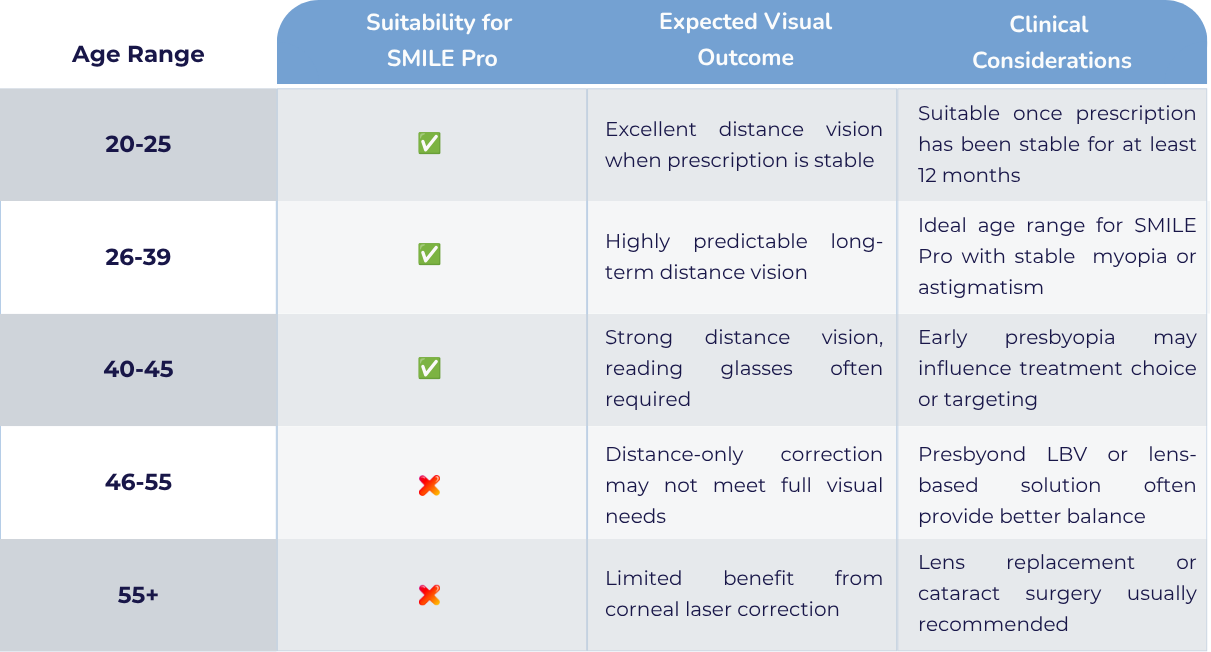
- Age: Generally 18 to 40 (though candidates up to 45 may be considered depending on presbyopia status).
Why not everyone qualifies for SMILE Pro?
At EuroEyes Hong Kong, we turn away some of the applicants for Smile Pro laser eye surgery. Why? Because safety comes first. If you have:
- Keratoconus: A condition where the cornea thins and bulges.
- Severe Dry Eye: While SMILE Pro is better for dry eye than LASIK, severe cases may need management before surgery.
- Unstable Prescription: Your vision must be stable for at least a year.
If you are not a suitable candidate for Smile Pro, we will let you know. We may recommend ICL (Implantable Collamer Lens) as a alternative for thin corneas or extreme prescriptions.
Key facts about SMILE Pro
Precision is enhanced through femtosecond laser technology. The laser procedure requires less time.
Minimally invasive technique (2mm incision) promotes rapid healing and reduces the risk of inflammation and infection.
Suitable for patients with myopia up to 1000 degrees and astigmatism below 500 degrees.
Preserves corneal integrity with no risk of corneal displacement.
Low risk of corneal nerve damage. More suitable for patients with dry eye syndrome compared to traditional Lasik.
Vision recovers rapidly, with noticeable improvement within days.
SMILE Pro Treatment Steps
1. Non-binding, personal consultation
During the preoperative examination stage, you will undergo a complete and comprehensive eye examination. We will assess whether you are a suitable candidate for SMILE Pro through this eye check and, based on the results, discuss a personalized surgical plan. Before the comprehensive eye examination, you should avoid wearing soft contact lenses for at least one week or rigid gas permeable lenses for at least two weeks, as long-term wear can alter the shape of the cornea.
2. Comprehensive preliminary examination
On the day of SMILE Pro surgery, it is recommended that you wear comfortable clothing and avoid driving yourself to our center. You may arrange for a family member or friend to accompany you, take a taxi, or use public transportation. You may eat and drink normally, but must refrain from smoking. On the day of the procedure, avoid using cosmetics such as face creams, lotions, makeup, and perfume, as they may increase the risk of infection or contamination in the surgical area.
3. The SMILE Pro treatment
This is a day surgery, with both eyes taking approximately 20 minutes. The doctor will verify your personal information and then apply anesthetic eye drops to numb the cornea. An eyelid speculum will be used to prevent blinking during the procedure, while the other eye will be covered.
The doctor will use the VisuMax femtosecond laser to create a lenticule inside your cornea. During this process, a contact lens will be used to stabilize the eye. You will see a bright spot but will experience minimal discomfort. The doctor will then make a small incision of no more than three millimeters to remove the lenticule through this opening. The incision will close naturally and does not require sutures.
After the surgery, the wound will heal naturally without the need for stitches.
4. After the SMILE Pro treatment
After the SMILE Pro surgery, you should avoid rubbing your eyes, continue using the prescribed antibiotic eye drops as instructed, and use artificial tears as needed. You may experience a foreign body sensation in your eyes after the procedure, but this feeling will gradually subside within a few hours. Using the prescribed eye drops can effectively alleviate any discomfort. Typically, you can return to work within two to three days. However, you should wait approximately one month before resuming contact sports and water-based activities to reduce the risk of infection. Follow-up appointments will be scheduled one day, one week, and one month after the surgery. Refrain from driving until your vision has stabilized. As each individual’s eye condition varies, please discuss any concerns with our ophthalmologist.
How does it work?
Refractive correction has usually involved the surgeon first cutting a flap, which was then folded back to remove corneal tissue point by point. SMILE Pro now enables laser vision correction without a corneal flap and thus minimally invasive.
1. Creation of the lenticle and the incision
The first step with the VisuMax is to create a refractive lenticule and a small incision of no more than two to three millimeters in the intact cornea, which can be done almost independently of the surrounding conditions and corneal condition.
2. Removal of the lenticle
In the second step, the lenticle is removed through the created incision. Since no flap is cut, this is only a minimal intervention in the biomechanics of the cornea.
3. Rehabilitation
Removal of the lenticle changes the cornea to achieve the desired refractive change.
Comparing SMILE Pro to ICL: Which is right for you?
At EuroEyes Hong Kong, we offer both Smile Pro and ICL (Implantable Collamer Lens) because no single procedure covers every human eye. ICL offers a different approach compare with SMILE Pro. How do you choose between the precision of SMILE Pro and the high-definition optics of an implantable lens? To understand the choice, you must understand the mechanism.
Smile Pro is a “subtractive” procedure. The laser sculpts your cornea by removing a microscopic layer of tissue (the lenticule) to change its shape. Once that tissue is gone, it is gone forever. This permanent reshaping is what corrects your vision.
- Maintenance-Free: Once the cornea heals (which is fast with SMILE Pro), there is no hardware in your eye. You can swim, box, or skydive without worrying about a lens shifting.
- Moderate Myopia Sweet Spot: For prescriptions between -1.00 and -8.00 diopters, SMILE Pro offers an balance of safety and results. The amount of tissue removed is minimal, leaving the eye strong.
- Lower Cost: Generally, SMILE Pro in Hong Kong is more cost-effective than ICL because it does not involve the manufacturing of a custom implantable lens.
You may consider SMILE Pro if you have moderate myopia, moderate astigmatism, healthy corneal thickness.
If your prescription is very high, a laser eye surgery would need to remove too much corneal tissue to be safe. This is where ICL shines.
- High Definition Vision: Because the ICL is a high-quality optic placed inside the eye, many patients report “High Definition” vision—sharper contrast and better night vision than they ever had with glasses.
- Extreme Prescriptions: ICL can correct myopia up to -20.00 diopters and astigmatism up to -4.00. For someone with -12.00 vision, Smile Pro eye surgery is usually not an option, but ICL is a perfect fit.
- Thin Corneas: If you were born with naturally thin corneas, removing even a small amount of tissue via SMILE Pro might be risky. ICL bypasses this problem entirely.
- Reversibility: Unlike laser surgery, ICL is reversible. If your vision changes drastically in 20 years, or if new technology is invented, the lens can be removed.
You may be suitable candidate for ICL if you have extreme myopia (above -10.00), thin corneas, or chronic dry eye (since ICL does not sever corneal nerves).
Long-term eye health and SMILE Pro
One of the most common questions we receive regarding SMILE Pro is about the long-term effects on the eye.
Patients want to know: “Is my eye weaker?” and “What happens when I get old?”
- Biomechanical Stability: The cornea is under constant pressure from inside the eye (intraocular pressure). Because Smile Pro leaves the upper layers of the cornea mostly intact (unlike LASIK, which cuts a flap through them), the cornea retains more of its natural biomechanical strength. In Smile Pro, the incision is only about 2-4mm, compared to the 20mm circumference cut of a LASIK flap. This structural preservation significantly reduces the risk of ectasia (bulging of the cornea) over the long term, making Smile Pro a preferred choice for those with active lifestyles or contact sports hobbies.
- Future Cataract Surgery: Decades from now, when you eventually develop cataracts (a natural part of aging), having had Smile Pro does not prevent you from having cataract surgery. In fact, the smooth optical surface left by SMILE Pro often makes the calculations for cataract lenses straightforward. Modern biometry machines can easily read a cornea treated with Smile Pro, ensuring that your future vision correction in your 60s or 70s is just as precise.
- Regression: “Will my myopia come back?” This is a valid concern. Because Smile Pro involves the physical removal of tissue, the effect is permanent. The tissue does not grow back. However, the eye can change due to internal aging of the crystalline lens. While the treated myopia is gone, natural aging changes can occur.
SMILE Pro FAQs
What kind of technology is SMILE Pro?
A femto-laser is an infrared light laser that treats tissue such as the cornea not only very precisely, but also with much less heat than other lasers. This proves to be a decisive advantage, especially in eye surgery. The femtosecond laser works on the basis of ultra-short light pulses. These last only fractions of a billionth of a second; their spot size is only 1/100 mm.
What equipment does EuroEyes use for SMILE Pro?
A specially developed laser system, the VisuMax femtosecond laser from Carl Zeiss, is used for SMILE Pro treatment. This laser has already proven itself in Femto-LASIK procedures with its sophisticated technology, precision and reliability. Through further development, it is now possible for the first time to prepare a lenticule within the intact cornea with millimeter precision, so that larger incisions and a flap can be dispensed with. In this way, the surrounding corneal tissue is spared as much as possible and the visual defect can be corrected in a targeted manner. In addition to its high precision, a particular advantage of femtosecond technology is that it is highly reproducible and accurately predictable even when high corrections are involved. In order to avoid unnecessary compression of the cornea, a contact lens is used that is adapted to the individual corneal anatomy and allows a precisely fitting treatment. This also avoids short-term visual loss, which can be caused by excessive intraocular pressure. In addition to state-of-the-art laser technology, a functionally sophisticated and ergonomically shaped patient couch has also been developed for SMILE Pro, allowing for maximum comfort and the most relaxed position possible during the procedure. During the operation, the patient’s position is continuously monitored and can be automatically readjusted if necessary.
What are the the key differences between SMILE Pro HK and Femto-LASIK?
The key differences between SMILE Pro HK and Femto-LASIK (femtosecond LASIK) surgery are as follows:
Flap vs. no flap: Femto LASIK involves creating a corneal flap, whereas SMILE Pro is a minimally invasive procedure without a flap.
Recovery: Both surgeries offer fast recovery times, but SMILE Pro is associated with less dry eye and a slightly quicker return to regular activities for some patients.
Range of Correction: Femto LASIK is suitable for correcting a wider range of vision problems, including myopia, hyperopia, and astigmatism. SMILE Pro is primarily focused on treating myopia.
Is SMILE Pro surgery suitable for patients with dry eye?
In SMILE Pro surgery, there is no need to create a corneal flap, which better preserves corneal integrity and stability while reducing postoperative complications. Since the cornea remains stable and tear film stability is less affected, SMILE Pro surgery is also suitable for patients with dry eye syndrome or those who are not suitable candidates for wearing contact lenses.
Is there an age limit for SMILE Pro?
The minimum age requirement for SMILE Pro is 18 years old. Your refractive error should have been stable for approximately one year before treatment. If you have any questions, please schedule a consultation immediately so we can carefully examine your vision.
What should I know about the SMILE Pro pre-operative examination?
The minimum age requirement for SMILE Pro is 18 years old. The pre-operative examination for SMILE Pro surgery takes approximately 1.5 to 2 hours. Before a comprehensive eye examination, you should avoid wearing soft contact lenses for at least one week or hard contact lenses for two weeks.
Is SMILE Pro eye surgery painful?
Different people have different pain tolerance levels. SMILE Pro eye surgery is a minimally invasive procedure. Numbing eye drops will be used before the surgery. Because the incision is extremely small and recovery is fast, there will only be a slight foreign body sensation during the procedure. Usually, by the second day after the surgery, you can see 80-90% of what you saw before using vision aids, and you will recover to almost full vision within 3 days. This data is a general guideline, and the exact results will vary depending on individual circumstances.
After SMILE Pro, when can I put on makeup again? Can I wear colored contact lenses?
- Makeup: Normal makeup is possible except for eye makeup. It is recommended to wait at least one month before put on eye makeup.
- Contact Lenses: The quality of contact lenses on the market varies greatly. Short-term wear has little impact, but long-term use is not recommended.
After SMILE Pro, when can I use my phone/computer?
Normal use of mobile phones/computers after surgery is not affected, but you should avoid excessive use of the eyes to affect recovery. Rest is appropriate depending on the condition of both eyes.
After SMILE Pro, am I allowed to drive? Or travel by high-speed rail/airplane?
- Driving: Driving is not affected after surgery, but safe driving is always advised.
- Air travel/High-speed rail: There are no restrictions on air or high-speed rail travel after surgery, but long-distance travel is recommended to be avoided during the early stages of recovery.
When can I resume exercise/fitness after SMILE Pro eye surgery?
Strenuous exercise should be suspended: Please avoid strenuous exercise within one month after surgery to prevent sweat from getting into the eyes and causing infection.
I am over 40 years old. Would you still recommend SMILE Pro to me?
For individuals who have been troubled by myopia for a long time, the more popular options currently available are SMILE Pro or ICL implantable contact lenses. While the age at which presbyopia appears varies from person to person, most people begin to experience related symptoms after the age of 40. Therefore, individuals aged 38 and above must also consider the “near future” when choosing a vision correction solution.
Presbyond LBV is a type of Laser Blended Vision method. It can be considered as an option for people aged 38 and above. Presbyond LBV effectively addresses myopia, hyperopia, and astigmatism while simultaneously mitigating the effects of presbyopia. However, it is essential to take a detailed preoperative examination to have a professional assess whether you are a suitable candidate for the procedure.